


Review these definitions and/or statements which are associated with Corsafety.ca's Confined Space Program.
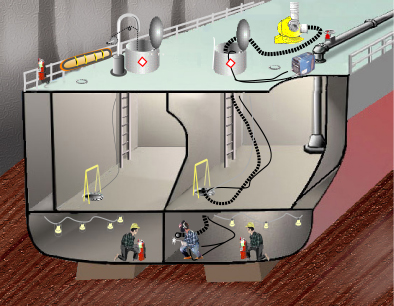
 A "confined space" is an enclosed or partially enclosed space that is not designed or intended for continuous human occupancy with a restricted means of entry or exit and may become hazardous to a worker entering it because:
 of its design, construction, location or atmosphere,
- of the work activities, materials or substances in it,
- the provision of first aid evacuation, rescue or other emergency response service is compromised, or
- of other hazards relating to it
- Acceptable entry conditions refer to conditions that must exist in a confined space to allow personnel to enter and to ensure they can safely complete their work while in that confined space.
- Attendant refers to a person stationed outside the confined space who monitors the authorized entrants, and performs the duties assigned to them by this written program. (Also called "lookout" or "hole watch")
- Authorized Entrant refers to personnel who are authorized under this written program to enter a confined space.
- Emergency refers to an event that could endanger an authorized entrant, whether it occurs inside or outside the permit space.
- Entry refers to the entrance of a person into a confined space. Note: Entry is considered to begin when the feet or head breaks the plane of entry into the space.
- Entry Permit refers to the written document that controls entry into a confined space, and contains all pertinent information required by local regulatory requirements.
- Entry Supervisor refers to the person designated with the responsibility to determine acceptable entry conditions, and to authorize, supervise, or terminate any entry.
- Hazardous Atmosphere refers to an atmosphere which may expose a person to the risk of death, incapacitation, injury, acute illness, or impaired ability to escape unaided from an emergency. An atmosphere is considered hazardous if it contains one or more of the following:
- Atmospheric oxygen concentration below 19.5% or above 23.0%.
- Flammable gas, vapours, or mists in excess of 10% of its lower explosive limit (LEL).
- Airborne combustible dust at a concentration that meets or exceeds its LFL, lower flammability limit, or (if the dust obscures vision at a distance of 5 feet).
- Atmospheric concentration of any substance where personnel exposure would exceed any listed toxic dose or permissible exposure limit.
- Any other atmospheric condition that is immediately dangerous to life and health.
- IDLH (immediately dangerous to life and health) refers to a condition that threatens loss of life, adverse health effects, or impaired ability to escape unaided from an emergency.
- Oxygen Deficient Atmosphere refers to an atmosphere that contains less than 19.5% oxygen content.
- Oxygen Enriched Atmosphere refers to an atmosphere that contains more than 23.5% oxygen content.
- Retrieval System refers to equipment which non-entry personnel can use to retrieve persons from a confined space in the event of emergency.
- Testing refers to a process used to identify and evaluate a potentially hazardous atmosphere with monitoring instruments.