


 Absorption
Many substances can be absorbed into the blood stream through contact with the skin. Often there is no indication that this has happened. If the M.S.D.S. or the chemical Hazardous Regulation has a "skin" notation to it or states that it can be absorbed then special protective gear is necessary. There is an assortment of gloves, sleeves, footwear and other clothing available for skin protection. The M.S.D.S will often give specific information as to what the clothing material must be manufactured from for safe use with that product. The skin on our eyes is the thinnest on our bodies and can be the number one way to know if we have been exposed to a chemical.
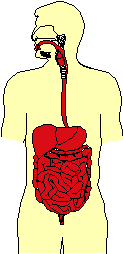
- Ingestion
No one intentionally "eats" or "Drinks" chemicals, but we may do so intentionally if we do not remove soiled clothing (coverall, gloves, hard hats) prior to eating and drinking. First aid for accidental poisoning is outlined on the M.S.D.S.
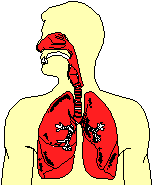
- Inhalation
At work the most common way that chemical substances enter our body is by breathing in the vapors in the air. To protect ourselves we must understand what vapors may be present, whether we can smell them or not, how much vapor is allowable and what we must do to protect ourselves. Continuous exposure to some chemicals over a long period of time can result in severe illnesses years later. The M.S.D.S. will outline the average safe levels but individual tolerances must be respected. Where respiratory equipment is necessary, workers must be certified as trained and competent when using it. If a worker has difficulty breathing or is exposed to a toxic vapor, remove the worker from the area to fresh air. Contact medical aid and begin first aid immediately.
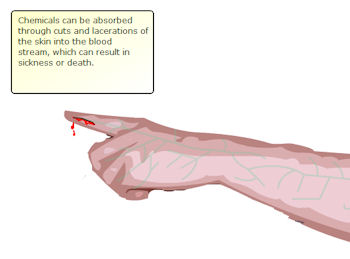
- Injection
Chemicals can be accidentally "injected" into our bodies through our skin or clothing By needles, pins or sharp objects that are contaminated with the chemical. By substances on tools or machinery that cut into us, even slightly, when we work with, or bump against them. The use of compressed air to blow down our clothing or ourselves is illegal. The human body can only with stand 6 psi of direct pressure on the skin. The average compressor has 80+psi in the air line.
 Try This...
12.3.1 12.3a Whats is Acute Poisioning? Try This...
12.3.1 12.3a Whats is Acute Poisioning? |